Interoperable Infrastructure in the AI Era

Interoperability in Climate and Atmospheric sciences
FAIR NetCDF Data

Problem

How can Ash train an extreme-rainfall prediction model using years of radar and atmospheric data without correcting each dataset manually?

Ash, the researcher featured throughout the interoperability lessons

What does “AI-ready” mean?

AI-ready infrastructure enables a defined machine-learning workflow to discover, access, interpret, retrieve, transform, and trace the data it needs with minimal dataset-specific manual intervention.

  • AI readiness is task-dependent.

  • No single data format or technology automatically makes a dataset AI-ready.

  • AI readiness therefore builds on interoperability, but extends beyond it.

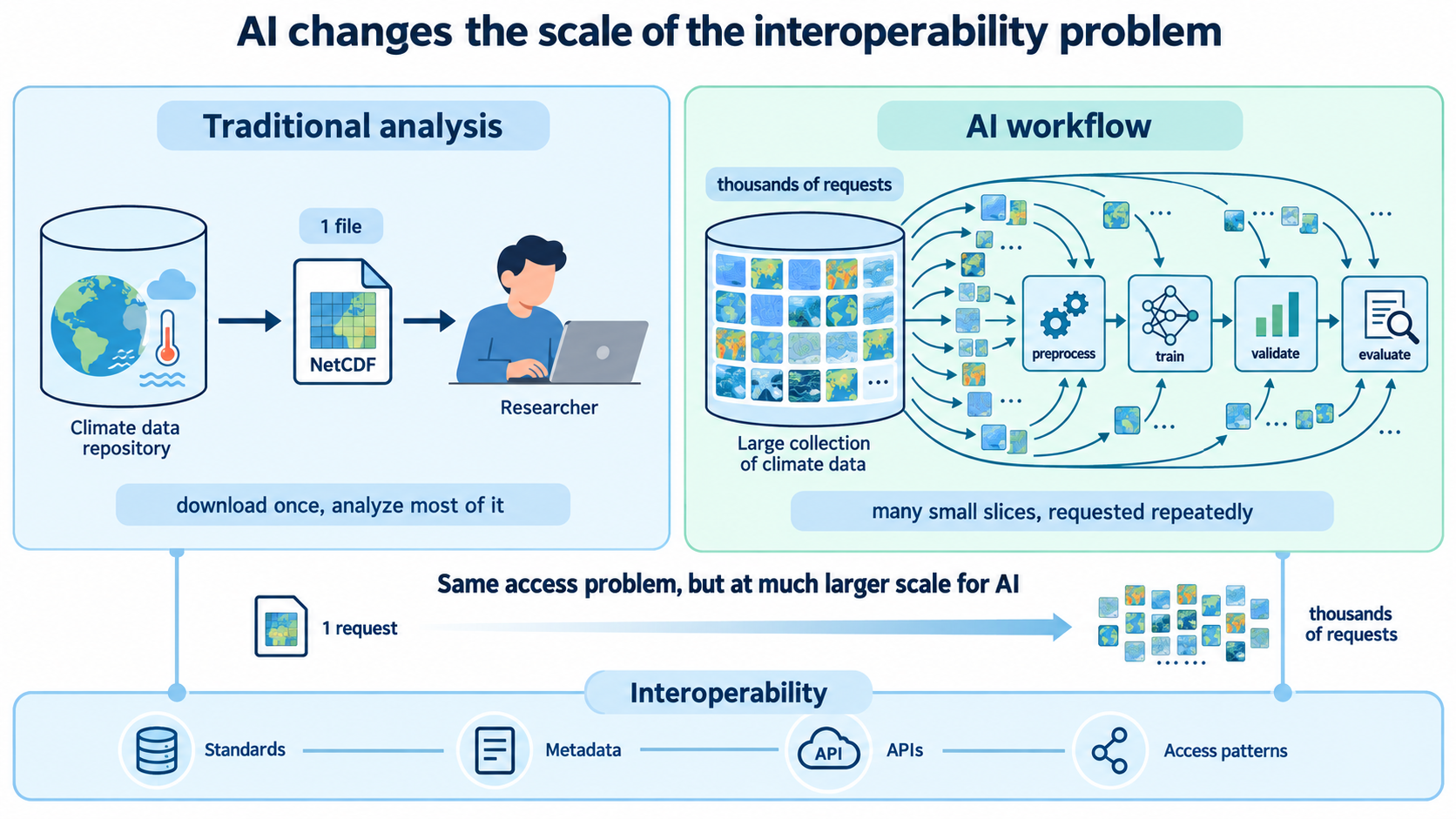
AI changes the scale of the interoperability problem

Interoperability does not guarantee trustworthy AI

  • Interoperability is an important foundation for automated and reproducible AI workflows, but it should not be confused with scientific validity or model quality.

  • Datasets can be structurally, semantically, and technically interoperable while still contain measurement errors.

  • Interoperability does not address questions of data quality, representativeness, modelling methodology, validation, uncertainty, and scientific interpretation.

Example : AI for Earth Observation

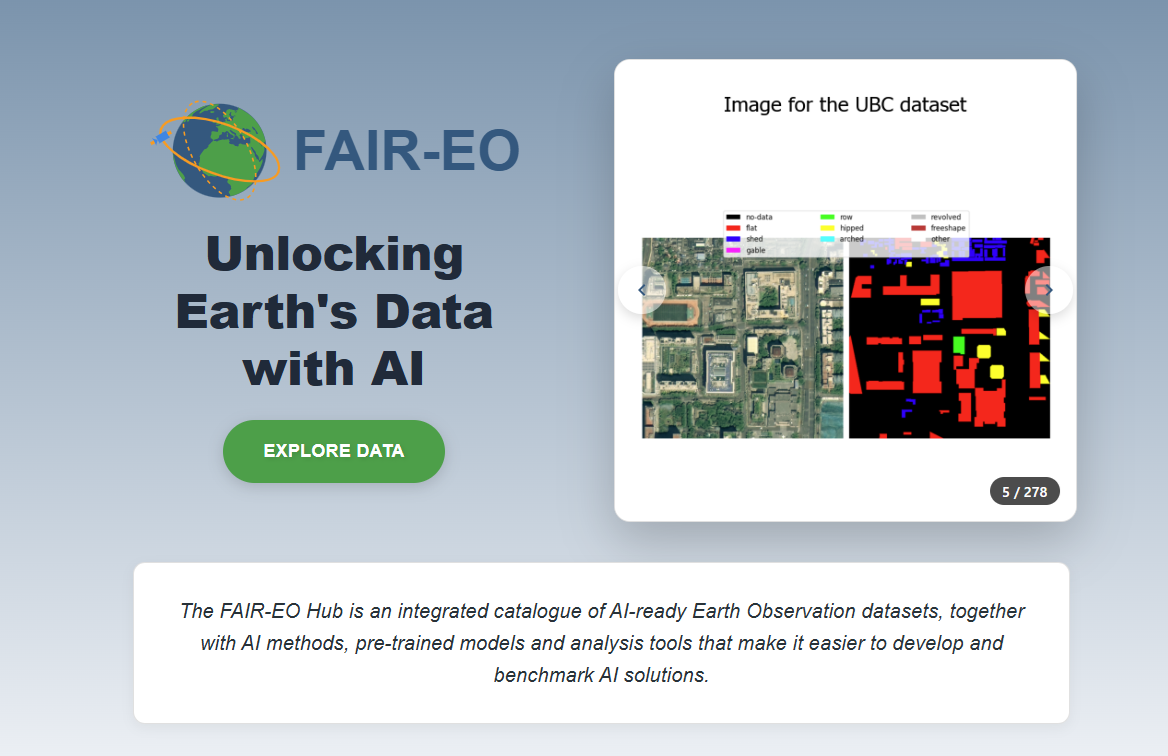
FAIR-EO: AI for Earth Observation

https://eodata.bvlabs.ai/ai4eo/#/

Anemoi European framework for AI

Anemoi: European framework for AI

https://www.ecmwf.int/en/about/media-centre/aifs-blog/2026/anemoi-european-framework-ai

Key takeaways

  • AI readiness is task-dependent. No single data format or technology automatically makes a dataset AI-ready.

  • AI does not introduce a new interoperability layer. Instead, automated AI workflows increase the importance of structural, semantic, and technical interoperability.

  • Interoperable source data provide a foundation from which task-specific AI training datasets can be constructed reproducibly.

  • Cloud-native layouts such as Zarr can improve selective and parallel access for suitable large-scale workflows, but they do not automatically improve semantic interoperability or data quality.

  • Persistent identification, provenance, and versioning complement interoperability by connecting models and derived training data to the exact source data and transformations from which they were produced.

  • Interoperability supports reproducible and inspectable AI workflows, but it does not guarantee that training data are representative, scientifically appropriate, unbiased, or sufficient for a particular model.