Technical interoperability I: Data access protocols

Interoperability in Climate and Atmospheric sciences
FAIR NetCDF Data

What is technical interoperability?

The Problem

How can one computer system access data held by another system?

How can a computer access scientific data stored on a remote system without necessarily downloading the entire file?

Ash, a researcher

Definition

Technical Interoperability concerns the mechanisms that allow independent systems to communicate and exchange data through agreed technical interfaces and protocols

Example: one variable, one period, one region

A climate dataset is stored in a research data repository. A researcher is interested in one variable, covering a particular period and a geographical region.


Consider two approaches:

  1. Download the complete file and perform the selection locally
  2. The remote infrastructure provides a mechanism to request only the required part

Which one is more suitable…?
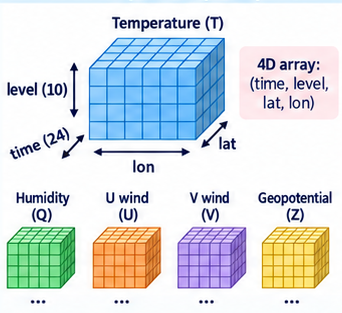
A 4D array (time, level, lat, lon) and the variables that share its dimensions

It depends on the task

  • Downloading the file is fine for small files, or when you need the complete dataset.

  • Requesting only the part you need matters for large datasets and automated workflows.

Concepts

DAP and OPeNDAP

DAP and OPeNDAP

The problem

Important scientific datasets were spread across institutions, each with its own way of storing and accessing data.

The idea

A common way to access data, wherever it is stored.


“A URL equals a dataset.”

“A URL with constraints equals a subset.”

Who is who?

DAP the protocol: how clients and servers talk
OPeNDAP the project and software ecosystem behind DAP
Hyrax, THREDDS data servers that implement DAP


Researchers just receive an endpoint URL. Data providers run the server.

Hands-on

Let’s make use of DAP

We will access remote NetCDF datasets stored in 4TU.ResearchData using the DAP protocol

https://edu.nl/9fh7g

Wrap-up

Key takeaways

  • Technical interoperability is about how systems agree to request and exchange data over a network
  • Storage is not access: remote data still needs an agreed access mechanism
  • DAP is the protocol. OPeNDAP is the project behind it. Hyrax and THREDDS are servers that implement it
  • With DAP you can explore a remote dataset without downloading it, and subset on the server before any data is transferred
  • A repository can be more than a place to store data: it can also make data accessible to machines, selectively