Semantic interoperability

Interoperability in Climate and Atmospheric sciences
FAIR NetCDF Data

Problem

Can others understand the meaning of the data correctly without making unnecessary assumptions?

Ash, a researcher

Notion of semantic interoperability

What is semantic interoperability?

A dataset is semantically interoperable when different people and software systems can interpret its variables, categories, relationships, and measurement context consistently because those meanings are expressed using documented, community-agreed terms and rules.

Good to know that:

  • This definition does not require every explanation to be written directly inside one file.
  • Meaning can be expressed through persistent identifiers that resolve to external vocabularies, code lists, specifications, instruments, methods.
  • What matters is that the references and relationships are explicit and machine-actionable rather than hidden in personal knowledge, filenames, or informal documentation.

Structure and meaning are different, but connected

  • The structural rule tells software where to find the information and which variable it describes, while the semantic rule tells software how to interpret that information.
  • Example:
float temperature(time, lat, lon);
    temperature:standard_name = "air_temperature";
    temperature:units = "K";

Structural rule: The standard_name attribute must be attached to the variable it describes. In this case, temperature.

Semantic rule: The value air_temperature must be a recognized/standard term, where it has a precise scientific definition.

Semantic resources to express meaning

Controlled vocabularies

Approved terms with definitions and governance e.g. CF

Code lists

Permitted values or codes for a particular field

Peristent identifiers

Links that connect a dataset or metadata element to an authoritative definition, instrument, method, vocabulary term, or other related resource.

Ontology

Formal concepts, properties, and relationships that may support logical reasoning

Semantic interoperability through the Climate and Forecast (CF) Conventions

  • The CF Metadata Conventions provide standard ways to describe the meaning and context of variables in NetCDF datasets. This helps researchers and software determine what the data represents and where and when it applies.

Main CF elements

  • standard_name — What is being measured? Gives a variable a standardised name with a defined scientific meaning, such as air_temperature or precipitation_flux.
  • units — How are the values expressed? Specifies the physical units of the variable. When a standard_name is used, the units must be physically compatible with its canonical units.
  • bounds and cell_methods — What does each value represent? bounds can describe the extent of a coordinate interval, while cell_methods describes operations such as a mean, sum, or maximum over space or time.
  • featureType — What kind of observations are these? Describes discrete sampling geometries such as time series, profiles, or trajectories.

Together, these elements make the scientific meaning and context of the data more explicit and machine-readable.

CF compliance does not guarantee that the scientific values are correct.
Exercise (plenum) : True or False?

A NetCDF file with dimensions, variables, and units is semantically interoperable by default.

False: : The NetCDF has to follow semantic conventions to be semantically interoperable.

Climate and Forecast (CF) standard names allow software to distinguish different kinds of temperature.

True : CF standard names distinguish concepts such as air_temperature, sea_surface_temperature, and surface_temperature through controlled terms and definitions.

Semantic interoperability mainly benefits human readers, not automated workflows.

False : Semantic interoperability is about shared and explicit meaning, which allows both humans and software to interpret the data consistently.

Two datasets using the same CF standard name can always be compared directly without further interpretation.

False : A shared standard name is strong evidence that variables represent the same physical quantity, but direct comparison still depends on coordinates, units, heights or depths, cell methods, bounds, etc.

Semantic interoperability can be achieved reliably through locally invented variable names, without community-agreed definitions.

False : Local names may be understandable within one project, but reliable interoperability requires mappings to shared definitions, vocabularies, or identifiers.

A descriptive long_name has the same machine-actionable status as a valid CF standard_name.

False : long_name is normally free text. A CF standard_name must be selected from the governed Standard Name Table and has a defined meaning and canonical unit.

What does CF-compliant mean?

  • A NetCDF file is CF-compliant relative to a declared CF version when it satisfies the requirements of that version and uses CF terms according to their defined meanings.
  • CF compliance report distinguish between:
    • requirements, which must be satisfied for conformance; and
    • recommendations, which improve interoperability but are not always mandatory.
  • Compliance is version specific, and a file may be compliant with one version but not another.

Compliance check

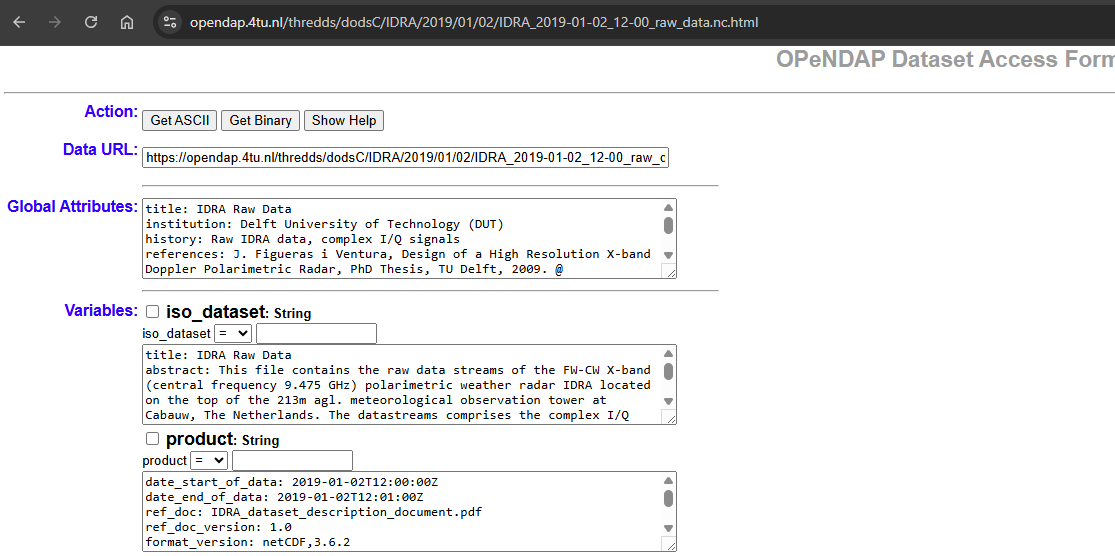
Data -> 900MB

https://edu.nl/4apba

OPeNDAP dataset access form for the IDRA dataset

or Download via command line:

curl -L -o data.nc https://edu.nl/4apba

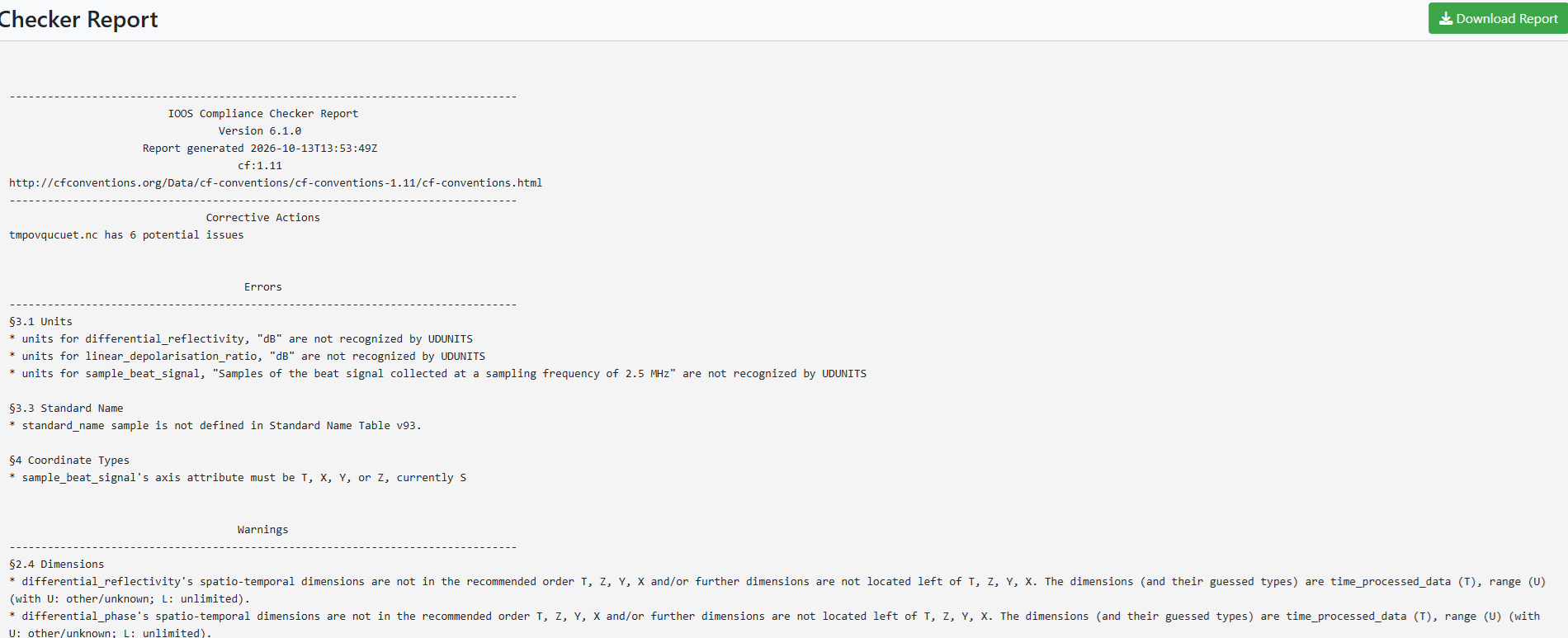
Example report

IOOS Compliance Checker report for the IDRA dataset

Key takeaways

  • Semantic interoperability concerns shared, explicit, and machine-actionable meaning.
  • Controlled vocabulary terms, units, coordinates, bounds, cell methods, grid mappings, flags, and qualified relationships work together to express scientific meaning.
  • CF compliance is relative to a specific version and does not prove scientific correctness, data quality, or suitability for a particular analysis.
  • The global Conventions attribute in the metadata of the NetCDF file is a conformance claim, not evidence that every requirement is satisfied.